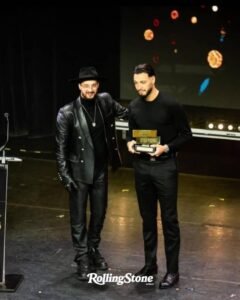
There are artists who rise, and artists who shift the atmosphere around them. SoolKing belongs to the latter, a singular force whose music slips across languages, continents, and identities with the ease of wind moving through open doors. Born Abderraouf Derradji, the Algerian singer, dancer, and genre-shaper has become one of the most influential North African artists of his generation, crafting a sound that is both intimate and global, proudly rooted yet endlessly in motion.
His universe is a constellation of rai, hip-hop, pop, and Afro rhythms, genres he doesn’t merely blend, but reimagines. For millions of listeners across the Maghreb, Europe, and the diaspora, SoolKing’s voice has become a compass: a reminder of home, a pulse of resilience, a proof that borders can be rearranged when you insist on your own path.
Rolling Stone Africa sat down with the artist whose songs have become chants in stadiums, whispers in immigration queues, and anthems in streets demanding change. What follows is a portrait of an artist who carries both the fire of his roots and the weight of an entire generation’s hope.
EXCLUSIVE INTERVIEW
RSA: Your music blends rai, hip-hop, pop, and Afro influences seamlessly. How has growing up in Algeria shaped the artistic fusion that defines the SoolKing sound today?
SoolKing:
My music mixes rai, hip-hop, pop, and Afro influences quite naturally. It is simply the result of my musical DNA. Everything I listened to as a child shaped me. Growing up in Algeria, it is normal to carry African influences, and then I also absorbed pop influences like Michael Jackson. All of that formed the artist I am today.
RSA: Many North African artists speak about carrying both the weight and the pride of representing their region on the global stage. What does it mean personally to be a voice for Algerian youth?
SoolKing:
It is an honor and a responsibility. At the end of the day, it is music but if it can inspire young people to pursue their goals and push as far as possible, then it nourishes me. I try to represent them in the best way I can.
RSA: Your journey from dancer to singer is not widely known. How did dance shape the way you understand rhythm, performance, and storytelling?
SoolKing:
The answer is almost in the question. Dance shaped my sense of rhythm, my musical ear, my stage performance, and my way of expressing myself. All of that comes from dance.
RSA: Your lyrics explore identity, struggle, resilience, and love. Which chapter of your life do you feel fans haven’t fully discovered yet through your music?
SoolKing:
I talk about what I live in the moment. Sometimes I dive into nostalgia and speak about my past. So there is always more to share, whether it is the present, the past, or even what I imagine for the future. It remains vast and open.
RSA: You’ve built a powerful connection with the diaspora. What do you feel unites Algerian and Maghrebi diasporic communities across continents?
SoolKing:
Culture, music, sport, success stories. When we see Algerian athletes or Maghrebi people succeeding internationally, it brings the diaspora together. The same happens with scientists, artists, or anyone who achieves something important.
RSA: “Liberté” and several of your songs became anthems. When a song unintentionally becomes political or societal, how do you navigate that responsibility?
SoolKing:
I do not manage anything in particular. I give my art to the people, and they do what they want with it. I cannot enter every topic that my music might be associated with. It’s humanly impossible. Music is something people use in their own way and for their own meaning.
RSA: North African musicians often face barriers in the global industry. What obstacles did you have to break through to be heard beyond the region?
SoolKing:
It wasn’t obstacles, it was means. Coming to Europe gave me the tools I didn’t have before to express myself artistically.
RSA: Your collaborations cross languages and cultures. What do you look for in an artist before deciding to create together?
SoolKing:
I look for the artistic side, the musical color, the image, the universe the artist carries. If it doesn’t speak to me, I simply won’t collaborate.
RSA: Algeria has a rich musical legacy. How do you see yourself contributing to the evolution of Algerian music?
SoolKing:
Through fusion. What I brought opened doors for a new generation who now feel free to mix genres. Before, rai was rai, chaabi was chaabi, and so on. When I arrived, I mixed everything with hip-hop, pop, reggaeton, and produced tracks like “Milano” or “Miami,” which found success in France. This new blend gave Algerian music fresh energy and young people today continue it very well.
RSA: With fame comes myth-making. What is one misconception about SoolKing you wish you could erase?
SoolKing:
Honestly, none. I don’t pay attention to that. People can invent stories or myths but my fans know me. I’ve always been transparent with them, so there’s not much to erase.
RSA: You’ve spoken about pain, ambition, and migration in your early years. What personal discipline or mindset kept you going when nothing was guaranteed?
SoolKing:
Determination. The desire to evolve, reach my objectives, and be heard. That is what kept me moving.
RSA: If you could send one message to the next generation of Algerian artists dreaming of a global career, what is the truth you wish someone had told you?
SoolKing:
Keep your head on your shoulders and stay focused on yourself and your art. Don’t pay attention to jealousy or unnecessary noise. Fame has good and bad sides. It’s not only positive, especially in the first years when you don’t yet understand how to handle it. With experience, you learn how to manage everything differently.
A Voice That Travels Beyond Borders
SoolKing’s story is the story of countless young North Africans who hold their past in one hand and their dreams in the other. Yet he stands out because he refuses to choose between the two. He has created a sound with no fixed address, one that speaks to the forgotten, the restless, the in-between.
In his music, Algeria becomes a rhythm. Migration becomes a verse. Resilience becomes a hook.
And for a generation navigating identity across continents, SoolKing isn’t just an artist,he is a reminder that you can come from everywhere and still belong fully to yourself.