I had the immense privilege of traveling alongside Meagan Good – Majors and Jonathan Majors as they embarked on a deeply meaningful journey on the African continent, and what I discovered was two people covered in grace; two artists walking with purpose; two human beings whose journey, like so many others, was never meant to be fully understood by the world, it was meant to be lived and experienced.
I discovered that their love is a love that builds even after life has tried to tear it down. A love that chooses hope over fear, purpose over distraction, and grace over bitterness. A love that understands that life is a long road that you cannot cross without having people pointing fingers at you.
Like the rose that grew through concrete, they continue to rise, to bloom, and to become the next, stronger, better version of themselves, not because the journey has been easy, but because they have chosen growth and elevation over noise.
It is a love that chose to become action; one that understands that legacy is not measured by what we achieve for ourselves, but by what we make possible for others.
Together, they chose to take on an ambitious mission: to become part of the transformation of Africa’s creative industries, not by leading from the outside, but by building with the continent’s filmmakers, producers, actors, actresses, writers, entrepreneurs and storytellers. It is a project with them and for them, rooted in the belief that the most meaningful collaborations are built on mutual respect, shared vision and the exchange of savoir-faire. While sharing decades of cinematic experience, Meagan Good Majors and Jonathan Majors are equally committed to learning from the remarkable expertise, creativity and storytelling traditions of African filmmakers and producers, recognizing that innovation flows in every direction.
Their commitment extends far beyond inspiration. It is rooted in advocacy, mentorship, collaboration and the creation of concrete opportunities. They are championing local talent, opening doors, building meaningful connections and investing in resources designed to strengthen the continent’s creative ecosystem for generations to come.
They understand a simple truth: while talent is universal, opportunity is not. They recognize that Africa is home to some of the world’s most extraordinary creative talent, and that by investing in its people, not only financially, but through collaboration, mentorship and shared knowledge, they can help ensure that more African stories are told by those who know them best. One country at a time, they are choosing not simply to tell Africa’s stories, but to stand alongside the people who will shape the future of global storytelling.
Some love stories exist only for the two people who live them. Others take root so deeply that they grow beyond themselves, blossoming into something capable of uplifting every life they touch. I witnessed love first anchored in one another, then generously extended to family, lifelong friends, and the countless strangers who have crossed their path, including those of us fortunate enough to accompany them back to the Motherland. In Guinea, I saw that love expressed not through grand declarations, but through quiet acts of humanity. I watched Jonathan pause to encourage and uplift children on the breathtaking Loos Islands (Îles de Loos), giving them his full attention while making incredible videos of the kids and reminding them that they mattered.
I watched Meagan search for a young woman who had been waiting patiently to meet her. She gently insisted that we not leave, that the car not move, until she had found her. When, despite her efforts, she couldn’t locate the young woman, she refused to let the moment end there. Instead, she took the time to write a heartfelt note and leave it behind, hoping it would find its way into the hands of the person who had waited so patiently. It was a simple gesture, yet it spoke volumes. People may forget your title; they may forget the awards you’ve won, the films you’ve starred in, or the stages you’ve stood on, but they will never forget how you made them feel. That is the quiet power of Meagan and Jonathan.
Their legacy is not built only through the characters they portray on screen, but through the dignity they extend to others when the cameras are no longer rolling. It is found in the conversations no one records, the moments no one posts, and the kindness that asks for no recognition. It is a love that understands that the greatest measure of influence is not how many people know your name, but how many people leave your presence believing a little more deeply in their own worth.
In Guinea-Conakry, a true paradise on earth, I watched two remarkable artists open not only their hearts, but also their art, their minds, their knowledge and decades of experience in film and storytelling. They came not to impose, but to exchange. Not to stand above, but to stand alongside. Not to be celebrated, but to invest in others. Not to take but to give.
Across Africa lives an extraordinary generation of filmmakers, actors, producers, writers and entrepreneurs whose creativity rivals any in the world. What too often separates dreams from reality is not ability, it is access: access to mentorship, to networks and to the rooms where possibilities become careers. That is why this journey matters.
From Guinea, Conakry and beyond, Meagan and Jonathan are choosing to use their platform to support Africa’s next generation of storytellers. They understand that the greatest legacy an artist can leave behind is not simply the films they create, but the people they inspire, the doors they open, and the opportunities they help cultivate for those who will shape the future. Perhaps that is the true meaning of A Love That Builds. Not a love measured by perfection, nor by public opinion, but by what it leaves behind. A love that refuses to be diminished by adversity; that creates space for others to dream, that reminds us that the strongest foundations are built not with applause, but with courage, generosity and faith.
And perhaps, in the end, the most beautiful love stories are not those that convince the world, they are the ones that quietly build a better one.
OUR EXCLUSIVE INTERVIEW WITH JONATHAN MAJORS & MEAGAN GOOD MAJORS
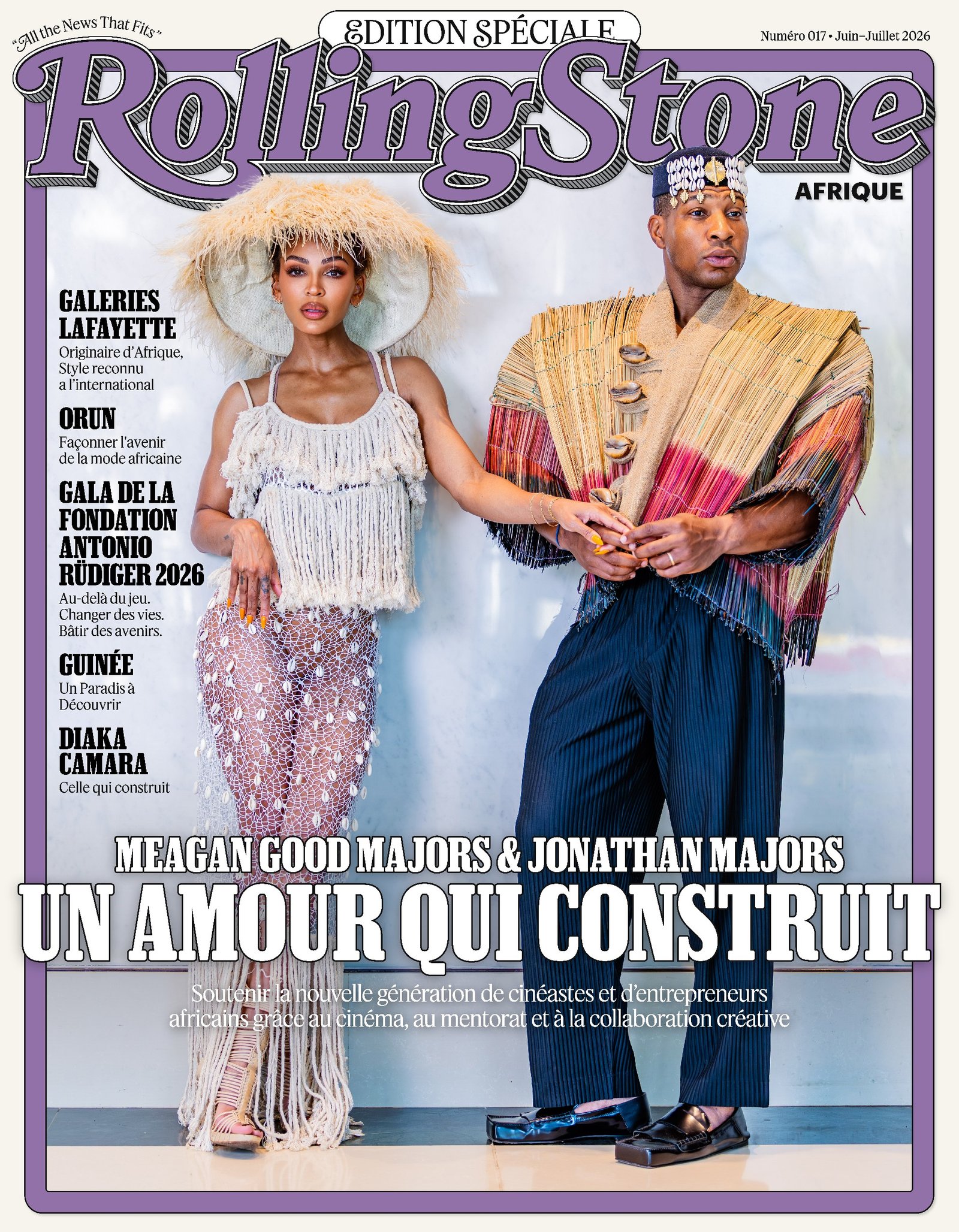
RSA: The title of this cover is A Love That Builds. What does that phrase mean to each of you, both in your relationship and in the work you are choosing to do together?
MGM: For me, it means love that is generative. A lot of love is beautiful but private. What God gave us feels bigger than the two of us, it has to spill over. In our marriage, building looks like sharpening one another, praying for one another, protecting one another’s calling. In our work, it looks like the same posture pointed outward. At the end of the day, it’s not really about us.. it’s about what we leave behind to make the journey, rather personally or professionally; easier for the young woman or young man behind us
JM: For me, a love that builds is a covenant, not a feeling. It’s the discipline of showing up — for God first, then for my wife, then for the work. Love that builds requires bricks. It requires blueprints. It requires a willingness to lay something down today that you may not sit inside of for twenty years. Meagan and I made a decision early on that our union would not just consume — it would produce. Produce peace in our home, produce art in the world, produce opportunity for people who never had a hand extended to them.
RSA: Rather than simply visiting Africa, you have chosen to invest your time in supporting filmmakers, actors, producers and entrepreneurs. Why was it important for you that this journey be rooted in collaboration and knowledge-sharing?
MGM: Tourism is beautiful .. but true Investment is a commitment. We didn’t want to come to the continent, take beautiful photos, and leave. Africa has poured into us, culturally, spiritually, ancestrally, long before we ever stepped foot here.
Coming as students first is a gift. But coming as partners is a blessing.
JM: The industry I come from too often extracts from Africa — its stories, its faces, its music, its aesthetics — and gives very little back in terms of infrastructure or authorship. We refuse that model. Collaboration means the African filmmaker is not a consultant on their own story; they are the author. Knowledge-sharing means what we’ve learned in Hollywood — the craft, the business, the pitfalls — belongs on the table for anyone here who wants it. And what they know, we sit down and learn. That’s the exchange. Anything less is colonial.
RSA: You recently traveled to Guinea and are now continuing this journey in the Democratic Republic of Congo. What have these experiences already taught you about Africa’s creative talent, and what has surprised or inspired you the most?
MGM: What has inspired me most is the joy. There is a myth exported about this continent that centers struggle. What I’ve witnessed is abundance, of creativity, of family, of faith, of fashion, of vision. I’ve met women producers, young female directors, entrepreneurs building empires from a laptop and a prayer. They don’t need to be discovered. They need to be resourced, believed, and put on the world stage. That’s a different assignment, and we accept it.
JM: Guinea moved me in a way I’m still processing. There is a rigor to the artistry there — the drummers, the dancers, the storytellers — that reminded me of the great theatre traditions I studied at Yale, except older, deeper, unbroken, and uncolonized.
I am still, honestly, blown away by the Mandingo griots who stormed the open space on the night of our citizenship ceremony. I don’t have the full language for it yet. These are men and women carrying centuries of history in their bodies, in their voices, in the kora, in the djembe — and they came through and consecrated the ground beneath us. It wasn’t a performance. It was a transmission. I felt my ancestors sit up. I felt my wife’s hand tighten in mine. I understood, in that moment, that we hadn’t just been granted citizenship on a piece of paper — we had been received. That’s a distinction I will carry for the rest of my life. What surprised me most beyond that night is the hunger. Not desperation — hunger. A generation of young filmmakers and actors who are technically gifted, spiritually grounded, and just waiting for the door to be cracked open a little wider.
RSA: You have spoken about the importance of legacy throughout your careers. When people look back decades from now, what do you hope they will say about the impact you made beyond film?
MGM: I want to be remembered as a woman who walked unapologetically in her authenticity. A woman made a conscious decision to spread unconditional love and light, even where it was unwelcome. A woman who never gave up or gave in on anything she believed is right. Hopefully a woman whose journey has and will give others permission to be just as unapologetic in their truth. I want young women — especially women of the African diaspora— to know that softness and strength can live in the same body, that a second chapter can be more anointed than the first, and that a marriage rooted in Christ can be a public witness. If our love helps one person believe that Gods plan for their life is perfect… If it reminds them that they deserve whole love, and God‘s highest plans no matter what they’ve done or what’s been done to them ..that’s legacy.
JM: Honestly? I hope they say, “The Majors’ really gave a f****.” (laughs.) I mean that. Strip away the awards, the credits, the magazine covers — at the end of the day, I want the receipts to show that we cared. That we cared about the craft. That we cared about the people. That we cared about the continent. That we cared about each other loud enough for other people to hear it and believe love like this is available to them too.
The film work — the box office, all of it — that’s temporary. The art is what lasts. If years from now the films still hold up, still feel true, still sound like the people and places they came from — that’s the legacy. The Majors’ really cared. Let the work say the rest.
RSA: Film has the power to change perceptions, preserve culture and inspire generations. What stories from Africa do you believe the world still needs to see?
MGM: Stories of restoration. The world is drowning in stories about how people failed. We need more stories about how people rise. Survival . We need Black love stories that aren’t tragedies but also triumphs. Healing . Beauty. Empowerment. We need African stories told in African languages, on African terms, that don’t have to be translated for a Western gaze to matter.
JM: We’re talking about telling the true Lion King story. Mansa Musa. The King of Mali. The richest man to ever walk the earth — a Black African emperor, a scholar, a man of faith, whose pilgrimage literally reshaped the global economy of the 14th century — and most of the world has never heard his name spoken correctly, let alone seen his life on screen. That is the epic. That is our epic. Rendered with the scale of Braveheart or Gladiator, but authored by the descendants of that empire, shot on that soil, in those languages, with those griots carrying the story the way they’ve always carried it.
And of course — stories of the diaspora. All of us. New York, Toronto, Conakry, Lagos, Cairo — yes, even you guys up there — Jo-burg, Hackney, Kingston… I could go on and on. Dakar, Salvador, Port-au-Prince, Marseille, Houston, Addis. We are one people scattered across a map that was drawn without us in the room, and every one of those cities is holding a piece of the story. I want to see films that let those pieces talk to each other. A kid in Brixton recognizing himself in a kid in Bamako. A grandmother in Kingston recognizing her own hands in a grandmother in Luanda. That’s the cinema I’m chasing.
Beyond that, I want to see the modern African city on screen — its tech, its fashion, its rhythm — not as an exotic backdrop but as the protagonist. And I want to see faith stories. Real ones. Not sanitized. The world still needs to see what a person looks like when they meet God on the other side of the fire.
RSA: Mentorship is at the heart of this initiative. What are some of the most valuable lessons from your own careers that you hope to pass on to young African filmmakers, actors, producers and entrepreneurs?
MGM: Every woman has survived something. My faith carried me through seasons I didn’t think I’d survive, and the other side of that valley is where I met the fullness of who I am and am still growing into— and, honestly, where I met my husband as the man God shaped him to be. Adversity teaches you deep understanding and compassion you cannot fake. So when we invest in others, we’re not investing from a pedestal. We’re reaching out with the same hand somebody once reached out to us.
JM: I’ve walked through fire — publicly. I won’t pretend otherwise. What that season taught me is that a man is not what the headlines say he is; a man is what he does when the lights go out and it’s just him and God. Adversity stripped me of everything I thought was mine and gave me back only what was real: my faith, my wife, my craft, my purpose. Now, when I meet a young artist who has been counted out, I recognize them. I don’t flinch. I sit down. I say, “Tell me your story.” That’s the investment — presence without judgment.
MEAGAN GOOD MAJORS
RSA: Throughout your career, you’ve consistently chosen projects that reflect purpose as much as success. How has your definition of success evolved over the years?
MGM: Walking in purpose with “why God created me” has always been the most important thing to me. Growing up in the business since I was a little girl, I learned very early on that being famous or a celebrity or “making it” was never gonna fill my spirit or give me an identity that someone or something couldn’t easily take away from me.
My standard of success is inner woven with that reality. When I feel close to God and am in alignment —that’s when I feel successful in my journey, in my existence and in living up to who God’s called me to be. And in that success; even in the dark moments-I know God will not only turn those moments or valleys around, but God will use them for my good, God’s glory and someone else’s journey… Being inside my purpose is the very definition of success to me now.
RSA: You have become an inspiration to many young women around the world. What message do you hope African girls with dreams of becoming filmmakers, actresses or entrepreneurs take away from your journey?
MGM: I hope that women and girls take away that there will be people who don’t believe in them along the journey.. people who don’t think they’re capable or good enough.. those who wish to quiet them and to dim their light . Do it anyway. Use wisdom along the way and protect your spirit . Do the work and never give up on you. Let the nay sayers fuel you on the days where you feel beat, insecure, unseen, not taken seriously… also let those same people inspire you to not be like them .. their unbelief isn’t about you —its their own insecurity and fear projected on you.
Remind yourself that your journey is so incredibly special and unique as a woman …especially as a woman of the African diaspora. You are the most exotic beings on the entire planet. Powerful, beautiful, perfectly imperfect with a voice, journey, Story, unlike any other beings in this world. Take up space. Take it up loudly so that other young women and little girls can see you and see themselves in you. Your existence… is epic.
And here’s a secret; these truths are why so many forces try to fight to dim ..us one day you will look at how hard the journey was and still is at times and understand that this reality too, is a compliment to your God-given greatness.
RSA: You’ve often spoken about faith being a guiding force in your life. How has your faith helped you navigate both moments of celebration and seasons of uncertainty?
MGM: Faith is every single thing. It’s sustained me, carried me and picked me up when I thought I couldn’t move. Faith is incredible during celebration—but it’s way more powerful in seasons of uncertainty. In fact, that’s when it matters most. When you don’t see the answer or the finish line or the fix… and you trust God anyways.. there’s a quote about not seeing the whole staircase and still taking the steps.. Faith requires that. Complete trust and transparency, even when we’re terrified… as we continue to walk it out that trust is made a whole. And it’s constantly evolving as we grow and get to know God more. But trust and faith in the perfect plan that God has for your life is absolutely everything. It’s a freeness and knowingness… a gift that transforms, heals and saves.
JONATHAN MAJORS
RSA: As an actor, you’ve built a reputation for portraying deeply complex and emotionally layered characters. How has your own life journey shaped the artist you have become?
JM: I was born in Lompoc, California, on a military base, to a family that moved the way military
families move — which is to say, often, and with the furniture half-packed. By the time I was a teenager in Cedar Hill, Texas, I had already been the new kid enough times to know that a face is a language, and if you learn to read it fast, you eat lunch with somebody. That was my first acting class. Nobody gave me a Meisner book. I got Meisner in the cafeteria.
My father was gone for a stretch of my childhood, and my mother — a minister, a force, a woman who could pray you into your right mind and cook you into your right weight in the same afternoon — held the line. I watched her. I am still watching her. Every character Inhave played who carries something heavy and refuses to set it down in public, that is her posture. That is her spine.
And here’s where life gets hella gnarly — where it becomes a screenplay only God could have written. My father is now down the road from me and Meagan, here in Atlanta. Stage four. Colon and prostate. The man whose absence once defined a chapter of my life is now the man I drive to see, the man I sit with, the man I cover.
I carried anger for him for a long time. I will not lie about that. But anger, if you let it sit long enough in the light of grace, turns into something else. It turned, in me, into a deep and stubborn love — the kind of love that shows up whether it feels like it or not. The kind of love that is also a responsibility. Not just for him. For my mother. For my daughter. For the whole family, which has been waiting, quietly, for somebody to close the circle. And I am not closing it alone. My wife is with me — every hospital hallway, every hard afternoon, every quiet drive home. Meagan is the steady hand on my back when the room gets heavy.
She reminds me, along with my Pastor Dharius and a team of therapists who have walked into the harder rooms of me and refused to flinch, that a man is only as whole as the love he lets in — and that healing is not a solo sport. The Lord works in mysterious ways. He really does. He gave me back my father in the season I needed him most — not the father of my imagination, but the actual man, mortalband tender and running out of time — and He gave me a wife, a pastor, and a circle of healers strong enough to walk that road with me. And in loving my father now, with all of them beside me, I am healing something in me that no role, no stage, no ovation ever could.
I got kicked out of school. I stole. I was homeless — slept in my car for a long stretch, an Oldsmobile, if we’re being specific, and Oldsmobiles have opinions about being slept in.
That season could have swallowed me. It didn’t, because of my uncle-dad — Uncle Chuck — and my Aunt Mary, who opened their door and by extension opened a future. There is a particular kind of grace in the family member who becomes a parent when the parent cannot. Chuck and Mary were that grace. They fed me. They corrected me. They let a boy who was carrying too much finally set some of it down at their kitchen table. I tell that story not for the drama of it but because I want the reader to know: the boy who ended up at Yale Drama did not arrive there clean, and he did not arrive there alone. He arrived there carried. And the carrying, and the being carried, is the craft.
When I played Nat Love in The Harder They Fall, when I stepped into Atticus in Lovecraft Country, when I walked into the ring as a fighter whose name changed weeks before webshot — my big brother, my friend, my director, MBJ, came to me and said we had to rename the character, and then, graciously, he let me be the one to name him. I gave him the surname of my maternal grandfather, Charles Henry Anderson Sr., because I needed the man throwing those punches to be answering to somebody of my blood.
Because I needed to be reminded I had the strength to play this role even on the mornings I couldn’t hold my arms up — they ached so bad from the day before — even at the dinners where I could not take another bite of food but still had macros to hit before I slept. That name was a lifeline.
Every time somebody on set called it out, I heard my grandfather answering back through me: keep going, boy. That is the kind of gift a brother gives you once, if you’re lucky, and MBJ gave it to me. I wasn’t inventing. I was translating. Every one of those roles is a room in the house my life built. I take my grandfather with me. I take my mother. I take my father, now, too — the one I have, in this eleventh hour. I take Chuck and Mary. I take Meagan. I take the boy in the Oldsmobile, and I let him finally speak in complete sentences.
Baldwin said the artist’s struggle is to tell the truth about himself. And the deepest truth I have found — deeper than any role, any headline, any hard-won lesson — is this: for a long time, I did not love myself. I did not even know I didn’t. I performed instead. I achieved instead. I carried instead. And then one day, quietly, without ceremony, I realized I had crossed over. I loved the man in the mirror. Not because he was finished. Because he was mine. That is a game changer. Everything I make now — every scene, every stillness, every silence I hold on camera — comes from that discovery. You cannot give an audience whatbyou do not have. And I humbly think I have something really worth giving now.
RSA: Every great career includes moments of triumph and moments of adversity. Looking back, what have your greatest challenges taught you about resilience, accountability and moving forward?
JM: Let me be plain, because plainness is its own kind of prayer. I have known a version of the Hollywood mountaintop. I have stood in the snow at
Sundance and heard a room rise for a film we shot on fumes and faith — The Last Black Man in San Francisco, a picture made with more love than money, which is the only way the good ones ever get made. And then, a few years later, I stood in that same mountain air for Magazine Dreams — a film I gave every fiber of myself to — and felt a room hold its breath in a way I will carry for the rest of my life. Two Sundances. Two seasons of my own becoming. I have also known the valley — the kind of valley where your name becomes a headline before it becomes a sentence, and every stranger has a verdict before you have a chance to say good morning. I will not pretend that season did not humble me. It did. It took
me down to the studs. And when you are down to the studs, you learn what your house was actually built on.
What I learned is this: resilience is not a highlight reel. Resilience is Tuesday. It is the therapist’s office at 9 a.m. It is the phone call to somebody you wronged, where your voice shakes and you make the call anyway. It is the gym at 5 a.m. when nobody is filming, when there is no premiere, when the only audience is the barbell and it does not care about your feelings — and that, honestly, is a relief. The barbell has never once asked me for a comment.
Accountability is the harder word. Accountability means you stop editing the story. You stop looking for the camera angle that flatters you. You sit down with what you did, and what you did not do, and you let it be true. And then — and this is the part nobody tells you — you forgive yourself enough to be useful again. Not enough to forget. Just enough to move.
Moving forward, for me, has looked like Meagan. Like my daughter — like building a bridge, plank by plank, to her and to the life she is becoming. That is the real work. Everything else is scaffolding. It has looked like the Waking Up app in my ear on early mornings when my own thoughts are too loud. It has looked like mental health conferences — sitting in rooms full of strangers who are all quietly doing the same brave work I am. It has looked like long, slow walks with my furry kiddos — Captain, Bishop, Hero, and Helsinki — four teachers with fur, who do not care about my résumé and only want to know if I am present.
And when the noise of the world gets to be too much, it has looked like a car, an open highway, and a cross-country drive with just me, the road, and my Heavenly Father. Some prayers are said kneeling. Some are said doing eighty through New Mexico with the windows down. Both count. Both have saved me. Baldwin said nothing can be changed until it is faced. I faced it. I am facing it. And on the other side of the facing, I found something surprisingly quiet: a
man I actually like. A man I want to take care of. A man worth walking across that bridge to
meet my daughter as. Not to be too navel-gazey about it — but yeah. That one. Him. I’m glad we finally met.
RSA: You’re now investing in emerging filmmakers and actors across Africa. What do you hope young creatives learn—not only about acting, but about discipline, preparation and excellence?
JM: I have been to Ghana. I have been to Accra and stood at Cape Coast Castle and put my
hand on a wall that remembers more than any of us. I have sat with young filmmakers in
Lagos who are shooting on borrowed cameras and unshakeable conviction. I have watched
a director in Johannesburg block a scene with the kind of precision that would make Kurosawa nod. Africa is not emerging. Africa is arriving — again — on her own terms. My job is to hold the door and get out of the way.
To the young ones, I say this, and I say it with love and a little bit of coach in my voice: talent will get you in the room. Discipline will keep you there. I want you to read Ousmane Sembène. I want you to study Djibril Diop Mambéty. I want you to know that Touki Bouki existed before you were born and it is still braver than most of what’s on a streaming service tonight. Know your history, your lineage, from all parts of the diaspora. Paul Robeson — who sang and acted and organized and paid a price for every note of it. Sidney
Poitier — who carried a whole people’s dignity into rooms that had never seen it and refused to set it down. Cicely. Denzel. Viola. But also Genevieve Nnaji. Also Mahershala’s discipline. Also the aunties in your village who taught you timing before you knew the word.
We are one long story, told in many tongues, on many shores. Know all of it. Claim all of it.
Preparation is not glamorous. Preparation is boring. Preparation is running the scene forty-seven times when you were off-book at fifteen. Preparation is showing up an hour early and asking the grip his name and meaning it. It is knowing where the camera is without looking. It is honoring the crew, because the crew is the church and the actor is just the guy who happens to be at the pulpit that day.
And excellence — excellence is not a trophy. Excellence is a habit. It is what you do when
nobody is watching, which, ironically, is when the ancestors are watching hardest. Every time you show up prepared, you are paying a debt to somebody who never got to audition.
Do not embarrass them. Do not bring them your excuses. Bring them your whole self, sweaty and studied and ready.
And listen — laugh, too. I wish I had done more of that sooner. Laugh on set. Laugh at yourself. This work is holy, but it is not humorless. Some of the best takes of my life happened right after somebody made a joke that had no business being that funny. Keep
your joy. Guard it. It is fuel.
That is what I hope they learn. Show up early. Read everything. Love the work. Love the people making it with you. And when it gets hard — and it will get hard — remember that you come from a continent that invented storytelling. You are not starting. You are continuing.
RSA: If there were one message you could leave with every young filmmaker, actor, producer, and entrepreneur across Africa after this journey, what would it be?
MGM: Don’t wait for permission. What’s inside you isn’t inside anyone else . You are an original and your story —rather be yours or the one you want to tell; is authentic to you … the world needs it . Tell it your way without reservation, hesitation or apology . And do not let anyone — not Hollywood, not the algorithm, not your own doubt — convince you that your voice needs to sound like someone else’s or be smaller to be heard. We need all of the fullness of who and what you and only you can bring.
JM: Build anyway. Build when they’re watching, build when they’re not. Build when the money comes, build when it doesn’t. Master your craft the way an athlete masters their body — daily, with reverence. Honor the ones who came before you and make room for the ones coming after. And remember: excellence is a form of worship. If you bring your full self, your full skill, and your full faith to the work, Africa will not just tell her own story to the world — she will tell the world’s story back to itself.