Boxing is one of the most popular sports in the world, with more than 300 million fans following it globally. The sport is also one of the hardest, demanding extraordinary physical strength, discipline, courage, and endurance from the boxers. But Africans have never shied away from the challenge.
Across generations, African boxers have walked into the ring against some of the world’s toughest fighters, carrying more than just their own ambitions. They carried the pride of their countries and the weight of an entire continent. From the early pioneers who broke through barriers to the champions who dominated their divisions, African fighters have left an indelible mark on boxing history.
They did more than win belts; they challenged expectations and helped establish Africa as a force in boxing. From Dick Tiger and Azumah Nelson to John Mugabi, these are the African boxers who made history.
Dick Tiger (Nigeria)
Born Richard Ihetu in Imo State, Nigeria, in 1929, Dick Tiger became one of the defining figures of African boxing during the 1960s. His nickname came from an opponent’s ringside observer, who watched his fight and reportedly exclaimed that he fought like a tiger. Dick Tiger’s career took him from Nigeria to Liverpool and eventually to New York, where he established himself among the world’s elite. In 1962, he defeated Gene Fullmer to become world middleweight champion. He later reclaimed the title after losing it to Joey Giardello.
In 1966, Dick Tiger moved up to light heavyweight and defeated José Torres to unify the division. His achievement was historic, as he was the only African boxer to hold undisputed championships at both middleweight and light heavyweight. Cancer unfortunately brought Dick Tiger’s life and career to an early end. He died in December 1971 at the age of 42, but his place in boxing history had already been secured. He was inducted into the International Boxing Hall of Fame in 1991.
Azumah Nelson (Ghana)
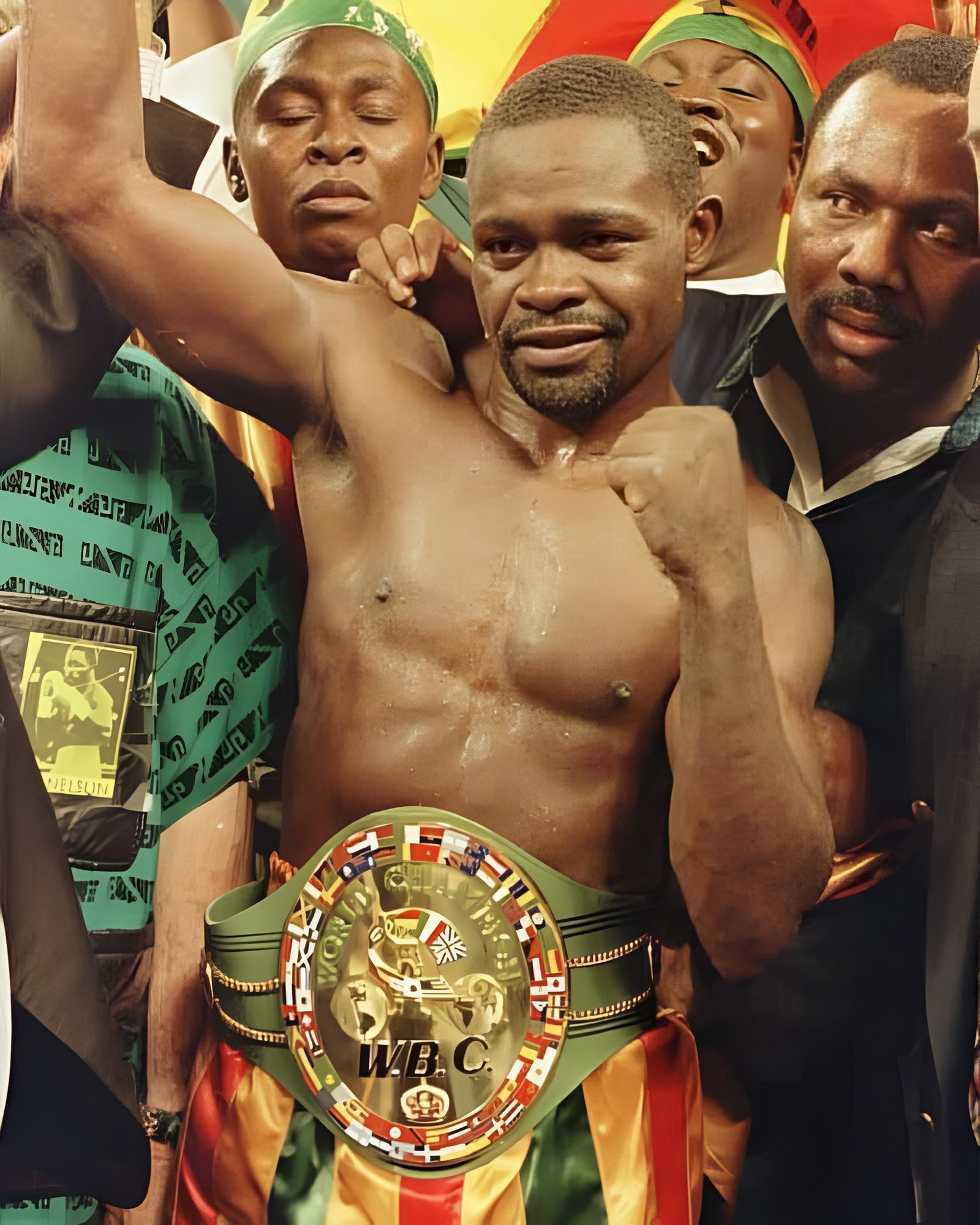
Azumah Nelson was born in Accra in July 1958. He rose through Ghana’s amateur ranks before becoming one of the most accomplished boxers Africa has produced. Known as “The Professor,” he combined speed, power, and an intelligent approach to boxing, and it earned him admiration far beyond Ghana. Nelson won gold at the 1978 Commonwealth Games and entered professional boxing with considerable promise. His international breakthrough came in 1982 when he was given a late opportunity to challenge Mexican great Salvador Sánchez for the WBC featherweight title at Madison Square Garden. Nelson lost after 15 rounds, but the performance announced his arrival on the world stage.
Two years later, he received another opportunity, this time against Puerto Rico’s Wilfredo Gómez. Nelson travelled to Gómez’s home territory and stopped him late in the fight to become WBC featherweight champion. He went on to win world titles in two weight classes, ruling the WBC featherweight and super-featherweight divisions and defending his championships repeatedly. His 1992 stoppage of Jeff Fenech earned him The Ring’s Upset of the Year, while he later regained the WBC super-featherweight title with a victory over Gabriel Ruelas. Nelson finished his career with a record of 39 wins, six losses, and two draws, including 28 knockouts.
Brian Mitchell (South Africa)
Brian Mitchell’s career was shaped by both achievement and circumstance. Born in Johannesburg in 1961, he became one of South Africa’s finest boxers while competing during the apartheid era. Because international boxing authorities restricted world-title fights from being staged in South Africa, he was forced to defend his championship abroad. Instead of stopping him, the restrictions turned Mitchell into one of boxing’s great road warriors.
He captured the WBA super-featherweight title in 1986 and successfully defended it 12 times, a record for the division. His career also included the IBF and lineal championships, and he finished with 45 wins, one loss, and three draws. That solitary defeat was later avenged. Mitchell retired after winning the IBF title from Tony Lopez in 1991, briefly returning several years later before finally ending his career in 1995. His achievements were later recognized with induction into the International Boxing Hall of Fame in 2009.
Harry Simon (Namibia)
Harry Simon is a two-weight world champion. His professional career began with an unbeaten run. He got the WBO light-middleweight title in 1998 after defeating Winky Wright and successfully defended the championship four times. He later moved up to middleweight and defeated Armand Krajnc to win the WBO middleweight championship. Injuries sustained in a car accident prevented him from defending the title, and he was subsequently stripped.
After years away from the ring, Simon returned in 2007 and continued to record victories. His comeback eventually produced another chapter in his career when, in 2013, he defeated Geard Ajetović to win the vacant IBF International light-heavyweight title. Simon successfully defended the title against Ajetović again in 2014.
Vic Toweel (South Africa)
Before Mitchell, another South African had already broken a major barrier. Vic Toweel was born in Benoni in 1928 and became South Africa’s first world boxing champion. In 1950, at just 21, he defeated Manuel Ortiz to win the undisputed bantamweight championship. Toweel’s reign lasted from 1950 to 1952, and his aggressive style made him one of the most important early figures in South African boxing.
His achievement was significant beyond the championship itself. Toweel gave South African boxing an early world champion to celebrate. He retired with a record of 28 wins, three losses, and one draw. He died in 2008 at the age of 80.
Ike Quartey (Ghana)
Ghana’s boxing tradition produced another exceptional champion in Ike “Bazooka” Quartey. Born in Accra in 1969, Quartey developed one of boxing’s most respected jabs and became a force in the welterweight division. He was guided by Azumah Nelson, linking two generations of Ghanaian boxing greatness. In 1994, Quartey stopped Crisanto España in the 11th round to win the WBA welterweight title. He successfully defended the championship seven times, defeating a succession of accomplished contenders.
Quartey’s career also included one of the most memorable fights of his later years: his 1999 meeting with Oscar De La Hoya in Las Vegas. Both fighters were knocked down, and De La Hoya eventually won by a close split decision in a result that generated considerable debate. Quartey retired with 37 wins, four losses, and one draw, including 32 knockouts.
Battling Siki (Senegal)
Decades before many of Africa’s best-known champions arrived on the scene, Battling Siki had already made history. Born in Senegal in 1897, Siki became the first world champion from sub-Saharan Africa when he defeated French boxing star Georges Carpentier in 1922 for the world light-heavyweight championship.
The victory was dramatic. Siki stopped Carpentier in the sixth round, producing a result that resonated far beyond boxing. At a time when African fighters faced enormous barriers to recognition, Siki’s achievement represented a breakthrough. His world title victory established a precedent that was followed by generations of African champions.
Cornelius Boza-Edwards (Uganda)
Born in Kampala in 1956, Cornelius Boza-Edwards moved to England and later built his professional career internationally. In 1981, he defeated Rafael Limón to win the WBC super-featherweight championship, becoming Uganda’s first world boxing champion. Boza-Edwards was known for his willingness to engage in demanding fights. His 1983 contest with Bobby Chacón is an example. The bout became a brutal, dramatic encounter and was recognized as The Ring’s Fight of the Year.
Although later challenges at lightweight ended in defeat, Boza-Edwards’ impact had already been established. Alongside fighters such as John Mugabi, he helped put Ugandan boxing on the international map. After retirement, he continued contributing to the sport as a trainer and was inducted into the Nevada Boxing Hall of Fame in 2014.
Hogan “Kid” Bassey (Nigeria)
Before Dick Tiger, Nigeria had Hogan “Kid” Bassey. Born in Calabar, Bassey became Nigeria’s first world boxing champion when he defeated Cherif Hamia in Paris in 1957 to win the featherweight title. Bassey dominated the fight and stopped Hamia in the 10th round, giving Nigeria a landmark moment in its sporting history.
His success continued beyond that championship victory. He defeated respected opponents, including Ricardo Moreno, and became the first person of Nigerian heritage to receive an MBE in 1958. After retiring, Bassey returned to Nigeria and contributed to the development of boxing at home. He became a director of physical education and wrote Hogan on Boxing, sharing his knowledge with a new generation.
John “The Beast” Mugabi (Uganda)
John Mugabi earned his nickname. Born in Kampala in 1960, he was one of the most feared punchers of his generation. His amateur career included a silver medal at the 1980 Olympic Games. As a professional, Mugabi developed a reputation for extraordinary punching power. His early career featured an extended knockout streak, and he became one of the most exciting fighters of the 1980s. That era was packed with legends, including Sugar Ray Leonard, Thomas Hearns, Marvin Hagler, and Roberto Durán.
Mugabi eventually found himself across the ring from Hagler in 1986, challenging for the middleweight championship. The fight became one of the defining contests of Mugabi’s career. He pushed Hagler through 11 punishing rounds before the champion stopped him. Mugabi continued fighting and eventually achieved his own world-title breakthrough in 1989, stopping René Jacquot in the first round to win the WBC super-welterweight championship.